
We often encounter a misunderstanding about Brain Aneurysms and Stroke. A ruptured Brain Aneurysm IS a form of Stroke.
Strokes are the No. 1 cause of disability and the No. 4 cause of death in the United States, according to the American Stroke Association. There are two main types of strokes: ischemic and hemorrhagic.
In laymen’s terms:
The main difference between an aneurysm and stroke has to do with how the two conditions affect blood vessels. An aneurysm is a bulging of a blood vessel that may rupture (hemorrhagic stroke). Conversely, a stroke is caused when oxygen and nutrients cannot get to parts of the brain because a vessel breaks or because of a blockage in the vessel (ischemic stroke).
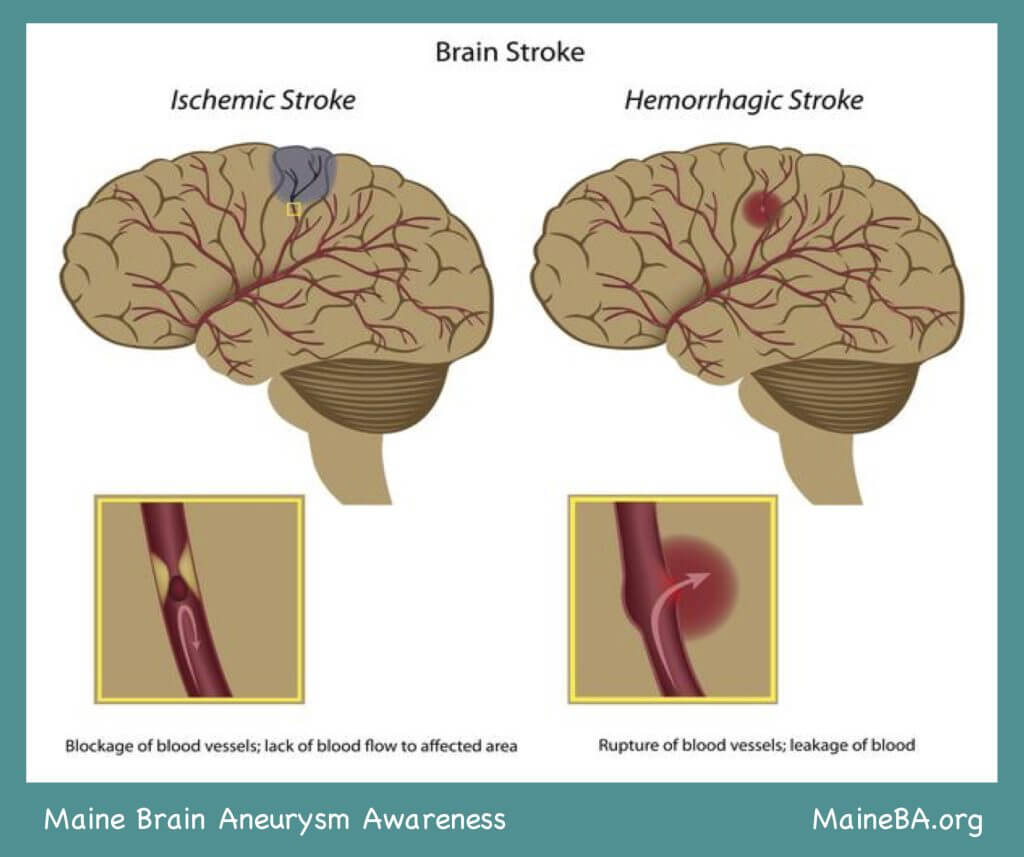
Ischemic strokes account for 87% of all stroke cases. When a blood vessel becomes blocked by fatty deposits, blood has trouble passing through to the brain. An ischemic stroke is caused by this obstruction. A thrombotic ischemic stroke occurs when a blood clot forms at the blocked part of a vessel. An embolic ischemic stroke occurs when a blood clot forms at another spot in the body and travels to a vessel in the brain that’s too small to let it pass.
A hemorrhagic stroke is caused by a weakened blood vessel that ruptures and bleeds into the brain – an aneurysm is a sort of bubble in a blood vessel that can grow until it bursts. That can cause a hemorrhagic stroke or subarachnoid hemorrhage (SAH) – often referred to as a “brain bleed”.
Despite the differences, an aneurysm and stroke have several characteristics in common. Both an aneurysm and stroke have to do with blood vessels and blood flow, and both can be fatal. BOTH SHOULD BE TREATED AS MEDICAL EMERGENCY – GET TO A HOSPITAL.