
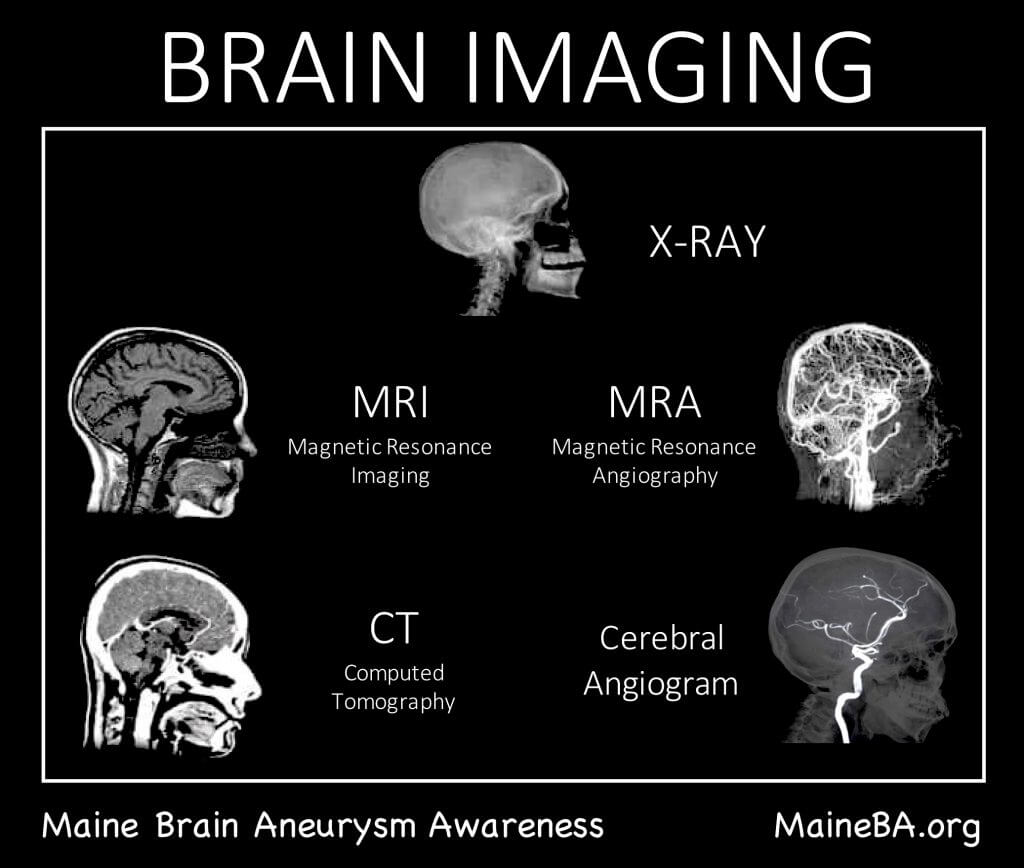
A brief description of various methods of imaging techniques used to “see” Brain Aneurysms.
X-RAYS are a type of radiation called electromagnetic waves. X-ray imaging creates pictures of the inside of your body. The images show the parts of your body in different shades of black and white. This is because different tissues absorb different amounts of radiation. Calcium in bones absorbs x-rays the most, so bones look white. Fat and other soft tissues absorb less and look gray. Blood vessels do not show at all and therefore do not show Aneurysms.
MRI & MRA are noninvasive and painless diagnostic tools used to view tissues, bones, or organs inside the body. An MRI (magnetic resonance imaging) creates detailed images of organs and tissues. An MRA (magnetic resonance angiography) focuses more on the blood vessels than the tissue surrounding it and is often used to identify brain aneurysm.
CT or CAT SCANS (computerized tomography scan) use computers and rotating X-ray machines to create cross-sectional images of the body. These images provide more detailed information than normal X-ray images. They can show the soft tissues, blood vessels, and bones in various parts of the body. A CT scan can identify a Subarachnoid hemorrhage (SAH); a life-threatening type of stroke caused by bleeding into the space surrounding the brain.
CEREBRAL ANGIOGRAPHY (angiogram) uses a catheter, x-ray imaging guidance and an injection of contrast material to examine blood vessels in the brain for abnormalities such as aneurysms. The use of a catheter makes it possible to combine diagnosis and treatment in a single procedure. Cerebral angiography produces very detailed, clear and accurate pictures of blood vessels in the brain and is therefore the best technique to identify a Brain Aneurysm.